Tuesday, 1 May 2012

Privacy, how secure is your PC?


In the ever changing technology world where everything is becoming computerised, one has to raise the question, is our information and personal details safe by using technology?
Two weeks ago Facebook announced that they have modified there terms of use policy in response to privacy concerns from most of the company’s 800 million active users worldwide. This was mainly done so that it could give Facebook the ability to censor some of their content online depending on their geographical location. This is one of many concerns users have about how security their personal information is on Facebook and more importantly if any of the pictures that is put upon Facebook that can be accessed by other people.
However despite this supposed change for the better terms in Facebook’s policy, it still doesn’t change the fact that the social website has many unanswered problems like cyber-bulling, child pornography and the more recent Trolls.
Another big fear that people and businesses have especially is the gradual conversion to the cloud. In an article I read, it talks about how even from the beginning there is privacy concerns with the cloud especially in relation to Webmail and online documents (such as Google Docs). It goes on to explain how other parties have the ability to access any data stored on the cloud and use it without the knowledge or permission of the company in question.
A similar case can be seen with the social app Path; the purpose of the app is so that people could essentially “Keep a journal or path of your life on the go”. However issues arose about how the address books of the users were being stored onto their servers, this meant that anyone working on the servers could easily gain access to the address books and locations of the users. As you can imagine this cause great controversy and once more raised the question about privacy.

If things like this are allowed to happen, is the route of businesses storing everything through technology really the best way to go? Or are the pen, paper and filing cabinet still the preferred choice.  


References: 


Memristor, Memory of the future?

As we have all seen, memory devices has been key to the success of computers, laptops, PCs and nearly all of today’s technology.  So as you can imagine the race to find smaller memory devices that can hold gigabytes or even terabytes of memory is constantly on.
The Introduction of Flash memory which is a form of non-volatile memory was a big stepping stone. Now one of these technologies is the memristor, a type of flash memory that “can remember how much current has passed through it” this in turn allows it remain at its current state at the moment when the current is turned off and starts back the minute it powers up again. With this ability it is believed that it could even “replace RAM as we know them”.
With this new technology it is believed that the average computer will be remarkably faster, and will be able to complete more difficult tasks and be able to remember a range a different states rather than the on and off states today's computers have.
It is believed that one of the issues facing developers of the new memristoer is the material used in the making of it. Researchers out in Korea published a paper stating how the use of titanium oxide based memristors have been successful.
In response to this, HP realise new papers about “Switching location of a bipolar Memristor, chemical, Thermal and Structured Mapping”. It seems that the route of using titanium oxide based material is one many companies are taking as IOPs science nanotechnology says how it continued its focus on this type of material.
So it seems that the memristor with all its ability to remember and read different currents  will take its rightful place as the next advancement in the use of flash and non-volatile memory.

References:


Tuesday, 28 February 2012

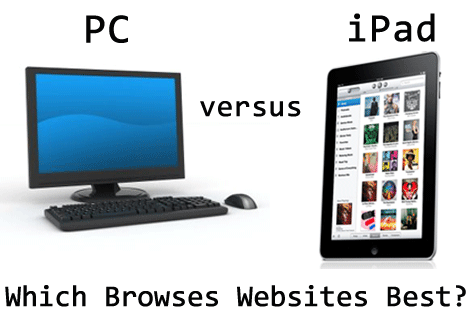
The iPad, will we really lose the need for desktops and PC’s?


I personally remember the days of sitting at a desk in front of a big, thick computer screen with a massive PC to go with it. With the recent development of e-business where buying online became the most popular thing to do, it seems that with the emergence of the iPad and other various products made by Apple, need to have that big PC in the house is becoming increasingly less.

With the sleek, easy portable and mobility of the iPad, one must ask themselves, who needs a desktop or PCs? Well there are many reasons for the success of the iPad and here are a few which I feel are influential to me:
Speed    
From the start the iPad is fast and with a click of a button, it’s on operational, and ready for the user. Whereas with the PCs, even with the broadband speed, my own PC at home would take several minutes in order to properly load.
Portability
The obvious advantage, (which is a big thumbs up with me) is the ability to bring it wherever you want. No matter where you are in the house, where it is in the living room or your own bedroom, the iPad works just the same. Unfortunately, the PC is the exact opposite, with its huge size it is stuck in a stationary position and at in today’s age of mobile devices is not practical.
However, I would not completely write off the PC just yet. A key factor which it has over the iPad is that it is a piece of equipment that is well known, everyone a basic knowledge whereas with the iPad, many people would be learning from scratch on how to use it.
I feel eventually I feel that the iPad will take over and become the dominant hardware used to access the internet due to the many overwhelming amount of advantages it has, but I do not believe it will permanently remove the PC from the picture altogether due to its established bases within the market

Blackberry vs. iPhone, who will win out?


As we all know,  in recent times the emergence of smart phones with wireless Internet capabilities have been a corner stone for easy use, e-business, and for those who want to do their work while on the go today. Here we look at two major competitors in this ever increasing sector: Blackberry and the iPhone. We will see the physical aspects aswel as the applications within these two titans of the technology industry.
Physical Features:
Between the two, the Blackberry is seen as the stronger and more durable of the two phones. The iPhone when it first came out quickly established a fairly negative notoriety for being breakable when dropped. Due to the delicate nature of the screen, a few drops on any surface would eventually lead to a cracked screen, however, Apple have since made various other products to deal with this problem including, hard cover cases, sleeves. On the other hand the blackberry is known for its strong durability cover, many people have dropped their Blackberry time after time and have come away with little more than a few scratches here and there.
Software Applications:
For me, having the right applications for the right job is key, and with the Iphone it does just that, with the ability and the know how to create their own applications, and with an endless amount of apps available in the iPhone app store, there always is one will suit your need no matter what the issue. The blackberry on the other hand has fairly limited offers and has been described as “The Blackberry App Store is like a pawn shop that only sells used 8-track players” (http://www.wired.com/geekdad/2009/08/great-geek-debates-iphone-vs-blackberry/) 

In the end, the choice of which smart phone is the better, is up to you.